
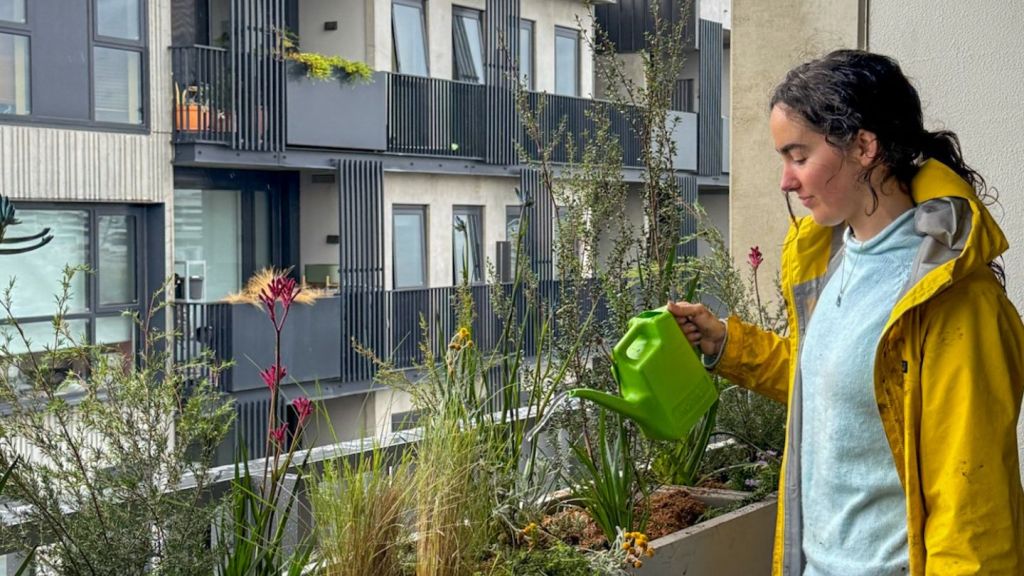
A Guide from EBV Resident and Ecologist Fiona
There is a particular kind of morning that a good balcony gives you. The light comes in sideways, there is a soft wall of green where the railing used to be, and somewhere in it a small bird you have never met is going about its business, completely unbothered by you. It sounds like something you would need a backyard for. You do not. You need a balcony, a few of the right plants, and someone who knows what they are doing to show you the way.
That someone is Fiona, an ecologist, landscape designer and East Brunswick Village resident who recently designed our new native gardens at Elm Grove and Fasteners Way. In this guide she shares exactly how to turn a bare Melbourne balcony into a native biodiversity oasis: lush, colourful, and quietly alive with the little creatures that come to find it.
Here at EBV, we have always believed a village is more than its buildings. It is the moments in between, and the spaces that make those moments easy. A balcony is one of those spaces. So whether you already call EBV home or you are simply curious about what apartment living in Melbourne can look like when it is done thoughtfully, this one is for you.
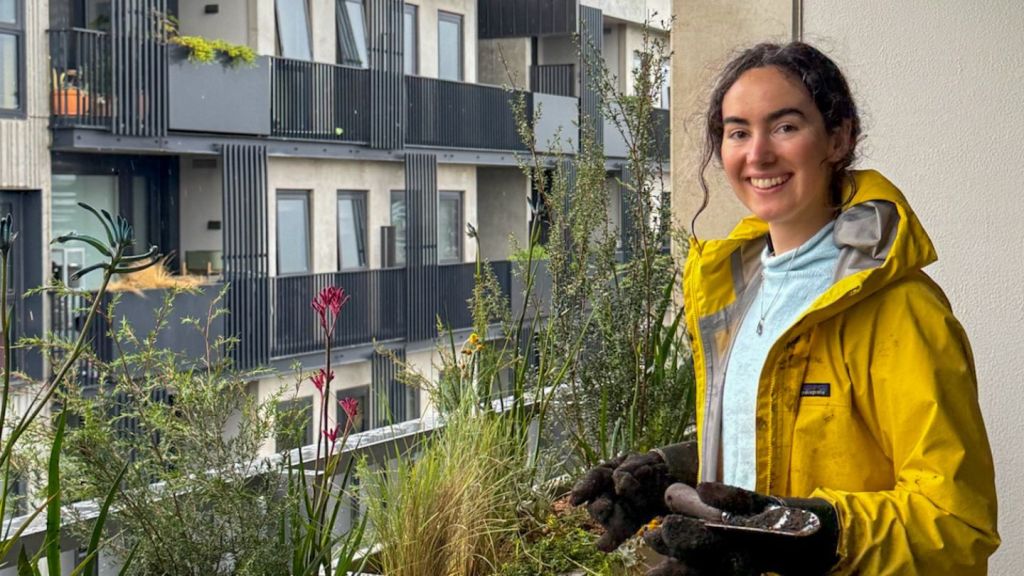
Meet Fiona: the ecologist behind EBV’s new native and biodiverse gardens
Fiona is not guessing. She has a background in Zoology, Marine Science and Biodiversity, with a focus on integrating biodiversity and Water Sensitive Urban Design into the places people actually live. During her four-year PhD at the ICON Science Lab at RMIT University, she specialised in designing urban blue-green spaces for biodiversity, which includes native species and ecosystems: Alongside global movements like nature-based sponge cities, designing for and with native biodiversity is increasingly at the forefront of global sustainability, and increasingly central to how good urban communities are built.
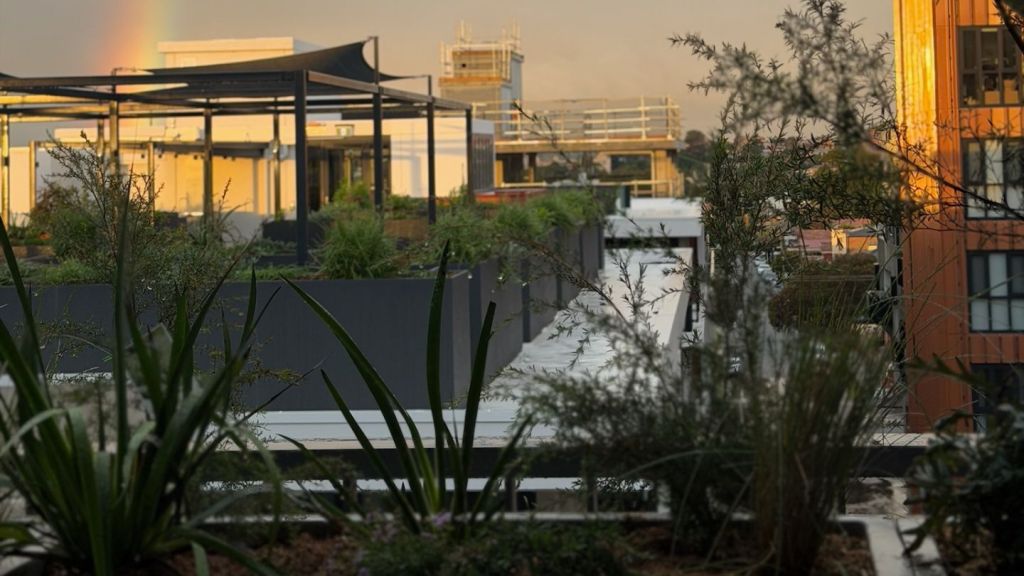
Over the past six months, she has carefully planned and designed the gardens at Elm Grove and Fasteners Way, planting the first seeds of what will become lush green spaces across the ground floor and rooftop levels. One very unique feature of these gardens is that they are not just green, but truly biodiverse, now including over 100 different native plant species to mimic the natural diversity of our local ecosystems. Every choice was made with the local ecosystem in mind: specifically, giving back to the native biodiversity of Merri-bek and the Victorian Volcanic Plains, the ecological region EBV calls home.
Her approach is grounded in deep observation, listening, and an intuitive understanding of what a space actually needs. The good news is that the same thinking scales all the way down to a single balcony. Here is how she does it.
Start with the right plants
The heart of a native balcony garden is plant choice. Get this right and much of the rest looks after itself, because these are plants adapted to Melbourne’s climate and the local ecosystem. They ask for less, and they give back more.
Fiona plants for two things at once: a screen of green with year-round colour, and genuine support for local wildlife. Here are the plants she reaches for, and why each one earns its place.
Grevillea and Leptospermum: colour that feeds the birds
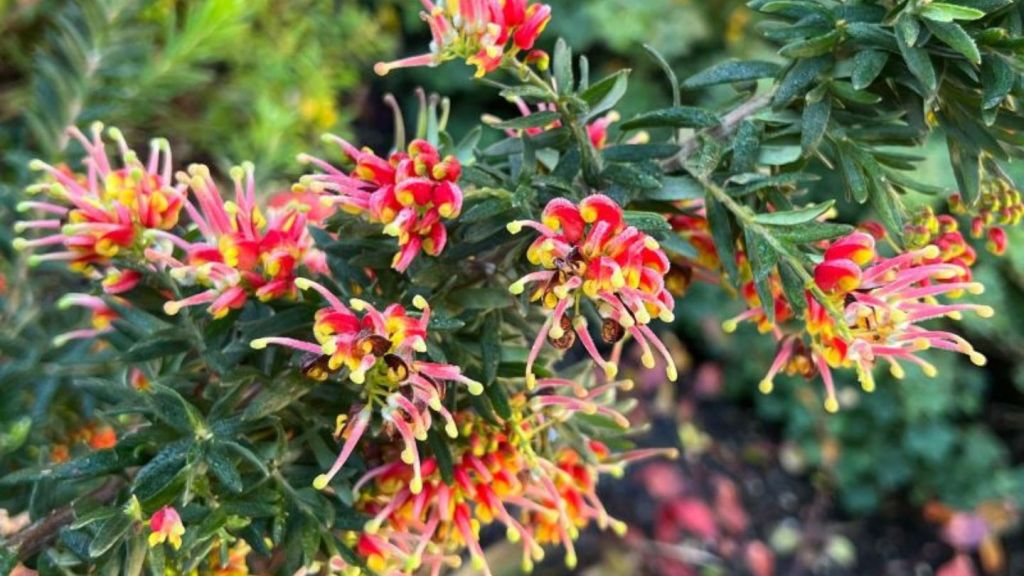
If you want your balcony to do more than just look good, start here. Grevillea and Leptospermum, (better known as Tea tree), are both excellent at attracting nectivorous birds such as the New Holland Honeyeater, Rainbow lorikeets, and the Little and Red wattlebirds. So when you plant them, you are not only adding bright, firework pops of colour, you are laying out a welcome mat for the birds that belong here.
Fiona’s picks for colour includethe Grevillea ‘Fireworks’, which brings vivid red to the garden. For the tea trees, the Leptospermum ‘Cardwell’ comes in both pink and white and does something rather lovely: it drapes and cascades over the edge of a balcony like a slow waterfall of flowers. It also grows to around two metres, which makes it a natural windbreak and a soft screen for a little privacy up high. If you want more variety, the Leptospermum ‘Rhiannon’ offers bright purple flowers and a wall of green about a metre tall, while the ‘Outrageous’ variety lives up to its name in hot pink.
Chrysocephalum: a local hero for bees and butterflies
Some plants are special because of where they are from. Chrysocephalum apiculatum, also known as the common everlasting or yellow buttons, is one of them. It is locally indigenous to the Victorian Volcanic Plains, the exact region EBV sits within, which makes it about as at home on a Brunswick balcony as a plant can be.
It is also a workhorse for biodiversity. Those cheerful yellow flowers are a unique source of nectar for a number of native bees, including the Blue-banded bee and the wonderfully named Teddy bear bee . It also supports the Australian painted lady butterfly, which, for the record, Fiona spotted in the EBV gardens just a few months ago. Plant this one and you are quietly rebuilding a small piece of the local food web, one flower at a time.
The underrated companions: native grasses and daisies
A great balcony garden is not only its showy flowers. A couple of quieter plants do an enormous amount of work.
The first is Poa, a native tussock grass (Fiona uses Poa labillardierei) that is native to this very region. It looks like a simple screen of green, but it supports a remarkably high diversity of insects, including the larvae of two local butterflies: the Common brown and the Banded grass-skipper . In other words, it is a nursery disguised as a grass.
The second is Brachyscome multifida, or cut-leaf daisy, which provides nectar for bees, butterflies and hoverflies alike. With a buffet of brachyscome nectar you are likely to attract an array of butterflies, such as the Small grass-yellow and Common grass blue butterfly blue butterfly. It is a small, generous plant that keeps the whole balcony humming.
A note on kangaroo paw
Kangaroo paw is not strictly native to Victoria, but it is an Australian native, and it is a brilliant balcony plant that makes a reliable nectar source for nectivorous birds such as the New Holland honeyeater, Eastern Spinebill and wattlebirds. The colour range is spectacular, from the pink-and-blue ‘Fireworks’ to ‘Masquerade’ (the first blue kangaroo paw), the pink ‘Bush Pearl‘, and tall landscape varieties in red and yellow that give you height and screening with colour. It is the plant to reach for when you want your balcony working hard all season long.
Don’t skip the drainage
Here is the tip that quietly separates a thriving balcony from a struggling one. Many native plants, and grevilleas in particular, hate wet feet. Root rot is their worst enemy, so good drainage is not optional.
When Fiona plants, she makes sure there is enough depth in the pot or planter box to anchor the height of the plant, but also enough drainage to let water move through freely. These planters have specific drainage materials and perlite through the soil to help with exactly this. And a small technique that makes a real difference: when you place a plant in, make sure it is not sitting lower than the surrounding soil line, so water drains away from the crown rather than pooling around it.
Get the drainage right and your plants will forgive you almost everything else.
Add mulch
Once everything is planted, there is one step people love to skip and really should not: mulch. Fiona uses eucalyptus or tea tree mulch, though any good organic bush mulch will do the job. It does three things, all of them quietly important.
First, it locks in moisture. When the sun hits your balcony, you do not want all your water evaporating straight back up into the air, and a layer of mulch keeps it in the soil where the roots can use it. Second, it insulates. It stops the soil from overheating on those hot Melbourne afternoons, which matters a great deal in a container up against a warm wall. Third, it keeps the weeds down, which means less work for you. Cover the exposed soil where weeds would otherwise take hold and you will find yourself weeding far less often.
Watering: generous at first, relaxed later
New plants need more support than established ones, so the watering routine changes over time. For roughly the first month, water your balcony garden about two to three times a week to help everything settle in and establish strong roots.
After that first month, you can gradually taper off. This is where choosing native plants really pays off. Because so many of these species are naturally adapted to Melbourne’s climate and rainfall, they are not high maintenance once established. They are built for exactly this place, which means a native balcony garden asks less of you over time, not more.
Your balcony is waiting
Hopefully this has inspired you to create your own native biodiversity garden, and to think about the little critters you might support or attract along the way. Because who says a native garden cannot be bursting with colour?
There is something fitting about all of this happening at EBV. Sustainability is one of our core values, and it has never been only about design. It is about the everyday choices residents make: composting, cycling, tending a shared garden, and yes, turning a balcony into somewhere a bee would fly across the neighbourhood to visit. Every EBV apartment is designed with liveability in mind, from the light that comes in sideways in the morning to the balcony waiting for its first pot of grevillea. Fiona simply showed us how to meet it halfway.
If you would like to be part of a village designed around exactly this kind of life, six kilometres from Melbourne’s CBD and built for community, sustainability and liveability, we would love to hear from you.
Register your interest in EBV apartments and come see what living here could look like.
Fiona is an ecologist, landscape designer and EBV resident, and the designer of the native gardens at Elm Grove and Fasteners Way. Follow along as EBV’s green spaces continue to flourish over the coming months.
